
Self-Exclusion – How It Works

What Is a Gambling Self-Exclusion?
A gambling self-exclusion is a formal request you make to a casino, a lottery corporation, or a regulator asking them to refuse you service for a period you choose. You sign it; they enforce it.
Three things define it and separate it from every other responsible gambling tool:
- It is voluntary at the start, binding afterwards. You choose to enrol. You do not get to choose to un-enrol mid-term.
- It is enforced by the operator, not by you. Your accounts are closed or frozen, new registrations are blocked, and marketing stops. Willpower is removed from the equation.
- It has a defined scope. A self-exclusion covers specific venues, specific websites, or a specific registry — never “all gambling everywhere.”
That last point is the one most players misunderstand, and it is where most self-exclusions fail. More on that below.
What Self-Exclusion Is Not
- It is not a diagnosis. Enrolling does not label you a problem gambler. Plenty of people self-exclude simply because a break sounds healthier than another Saturday night.
- It is not a credit or bank block. Your money is still spendable elsewhere unless you set that up separately.
- It is not global. A registration in British Columbia does nothing in Ontario, and no Canadian program reaches offshore sites.
- It is not treatment. It buys you distance from the product. What you do with that distance is the actual work.
Self-exclusion is meant to be hard to undo. Once you activate it, you cannot simply change your mind and ask support to reopen the account. The exact rules depend on where you live, and Ontario changed its system in May 2026. This guide breaks down how self-exclusion works across Canada and whether there is any way to cancel it early.
Seven Steps Through Self-Exclusion
The details vary by province, but self-exclusion usually follows the same basic path. You choose the scope and term, verify your identity, and the restriction takes effect.
 Choose your scope.
 Online only, land-based only, or both. Some programs (Alberta’s, for example) let you pick all three combinations in a single form.
 Verify who you are
 This is the part that makes the block enforceable. Expect a government-issued photo ID and, increasingly, a live selfie for facial matching. Ontario’s BetGuard requires both. B.C. casinos scan ID at the door against the exclusion list.
 Pick a term
 Standard options run 6 months, 1 year, 2 years, 3 years, or 5 years. Some programs offer custom lengths. Ontario’s regulator requires every licensed operator to offer at least 6-month, 1-year, and 5-year options.
 Your accounts are closed and your balance returned
 Under AGCO rules, a self-excluded player is logged out immediately and cannot log back in. Any remaining funds are paid out, and pending wagers are handled according to the operator’s terms. You do not forfeit your money.
 Marketing stops
 Emails, push notifications, bonus offers, VIP calls — all of it must be switched off. Ontario operators have to strip self-excluded players from marketing lists on a mandated deadline, not “eventually.”
 Enforcement begins
 Online, this is a real-time database check at login, registration and deposit. In land-based venues, it’s ID scanning and, at OLG properties, biometric facial recognition at the entrance.
 The term runs out - and nothing happens automatically
 In most programmes, you must actively go through a reinstatement or “return to play” process. If you do nothing, you stay excluded. That default is deliberate.
The steps themselves may look familiar, but Ontario changed where they lead.
Ontario’s New Self-Exclusion System
Ontario ran its regulated iGaming market for four years without a single, unified way out. If you had accounts at nine sportsbooks, you had to self-exclude nine times. That gap closed in May 2026.

BetGuard – Ontario's Centralized Self-Exclusion Registry
BetGuard went live on 14 May 2026, operated by iGaming Ontario under AGCO Standard 2.14.1. It is Canada’s first centralized self-exclusion register for a competitive online market.
| Feature | Detail |
|---|---|
| Who can register | Ontario residents aged 19+ |
| Where | BetGuard’s own website — no gambling account needed |
| Time to complete | Roughly five minutes |
| Verification | Government photo ID + facial verification |
| Terms available | 6 months, 1 year, 5 years, or a custom length |
| Coverage | Every regulated iGaming site in Ontario (77 sites from 44 licensed operators at launch) plus OLG’s online platform |
| Speed of effect | Operators must apply the block within the regulator’s mandated window and log you out of active sessions |
| Marketing | All direct promotional contact must stop |
| Support | 24/7 agents, English and French, with direct transfer to ConnexOntario |
| Can it be cancelled? | No. It can be renewed or extended, never shortened |
Two design decisions matter more than the rest. First, you don’t need a casino account to register — that removes the perverse step of logging into a gambling site to stop gambling. Second, you self-exclude once, not once per operator. As ConnexOntario’s leadership put it during the launch, that reduces the amount of willpower the process demands from someone already struggling.
My PlayBreak – OLG's Program for Land-Based Venues and OLG.ca
BetGuard does not cover physical casinos. That is still My PlayBreak, OLG’s self-exclusion program run alongside its PlaySmart responsible gambling platform.
- Covers: all Ontario casinos, Charitable Gaming Centres, and OLG.ca
- Terms: 3 months, 6 months, 1, 2, 3, 4 or 5 years
- Enforcement: biometric facial recognition at casino entrances, ID checks by security
- Return: a defined “Return to Play” process at the end of your term, with renewal offered by email or letter before expiry
If you want to be blocked both online and in person, you need both registrations. They are separate systems with separate sign-ups. This is the single most common gap in Ontario self-exclusion coverage.
Operator-Level Self-Exclusion Still Exists
AGCO Standard 2.14 still requires every licensed operator to run its own self-exclusion program on its own site. BetGuard did not replace that — it sits on top of it. Site-level exclusion remains useful if you only want to shut one specific brand out rather than the whole market.
| BetGuard | My PlayBreak | Operator-level | |
|---|---|---|---|
| Scope | All regulated Ontario iGaming sites | Ontario casinos, cGaming, OLG.ca | One brand only |
| Sign-up | BetGuard website | OLG / casino venue | Inside your account |
| Best for | Cutting off all online play at once | Physical venues | Quitting one specific site |
| Cancel early? | No | No | Depends on operator terms |
Signing up is now simpler across Ontario’s regulated market. Getting out of an active self-exclusion is far more restrictive.
The Limits of Cancelling Self-Exclusion
This is one of the highest-volume searches on the topic, so here is the direct answer.You cannot cancel a self-exclusion early. Not in Ontario, and not anywhere else in Canada.
iGaming Ontario made this explicit at BetGuard’s launch. Once you register, the term you selected stays in place until it ends. You can extend it, but you cannot shorten it. Similar fixed-term rules apply to BCLC’s Game Break and Loto-Québec’s self-exclusion program. The restriction is deliberate: self-exclusion is designed to stay in place even if you later change your mind.
The term has to run its course first. Even then, access is not necessarily restored the moment the exclusion expires.
What Actually Happens at the End of the Term
BetGuard: your term expires on the date you selected. You can log in to your BetGuard account at any point during the exclusion to check your status or end date — and to extend it, if you want more time.
My PlayBreak: OLG contacts you before expiry with renewal options and a Return to Play process. If you registered under OLG’s older self-exclusion program, you request a renewal form from OLG’s Support Centre at 1-800-387-0098.
British Columbia: returning from Game Break requires completing an online course called Game Plan plus a Return to Play form. Reinstatement is a process, not a button.
If You’re Mid-Term and Want to Gamble
The urge to look for a workaround can come after self-exclusion, but that does not mean the system has failed. In fact, this is exactly when the restriction is meant to hold.
Self-Exclusion Across Canada
There is no national self-exclusion registry in Canada. Each province regulates gambling within its own borders and runs its own list. Registries don’t share data, so if you move or travel, you register again.
| Province | Program | Scope | Typical terms |
|---|---|---|---|
| Ontario | BetGuard (iGO) | All regulated iGaming sites + OLG online | 6 mo, 1 yr, 5 yr, custom |
| Ontario | My PlayBreak (OLG) | Casinos, cGaming centres, OLG.ca | 3 mo – 5 yr |
| Alberta | AGLC Self-Exclusion Program | Choose: regulated iGaming, land-based casinos & REC, or both | 6 mo, 1, 2, 3 yr |
| British Columbia | Game Break (BCLC / GameSense) | Slot venues, bingo halls, community gaming centres, PlayNow.com | 6 mo, 1, 2, 3 yr |
| Quebec | Loto-Québec self-exclusion | Casinos, gaming halls, online account | Irrevocable for chosen term |
| Manitoba / Saskatchewan | Provincial lottery corporations | Provincial venues + PlayNow | Comparable terms |
| Nova Scotia | Voluntary Self-Exclusion Program | Provincial casinos | Via RG Resource Centre |
| New Brunswick | Self-exclusion via RG Information Centre | Casino New Brunswick | Via centre |
Alberta is worth watching. When the province opened its private iGaming market on 13 July 2026, it launched with centralized self-exclusion already running — the reverse of Ontario’s order. AGLC’s system lets a player exclude from all registered iGaming platforms, all land-based casinos and racing entertainment centres, or both, from a single sign-up, with every registered operator required to integrate by API before going live.
The Gap: Offshore Sites and Why Self-Exclusion Isn’t Enough on Its Own
A provincial registry only reaches operators that the province licenses. Offshore sites licensed in Curaçao, Anjouan or elsewhere are not connected to BetGuard, AGLC’s system or any Canadian registry, and they have no obligation to honour your exclusion.
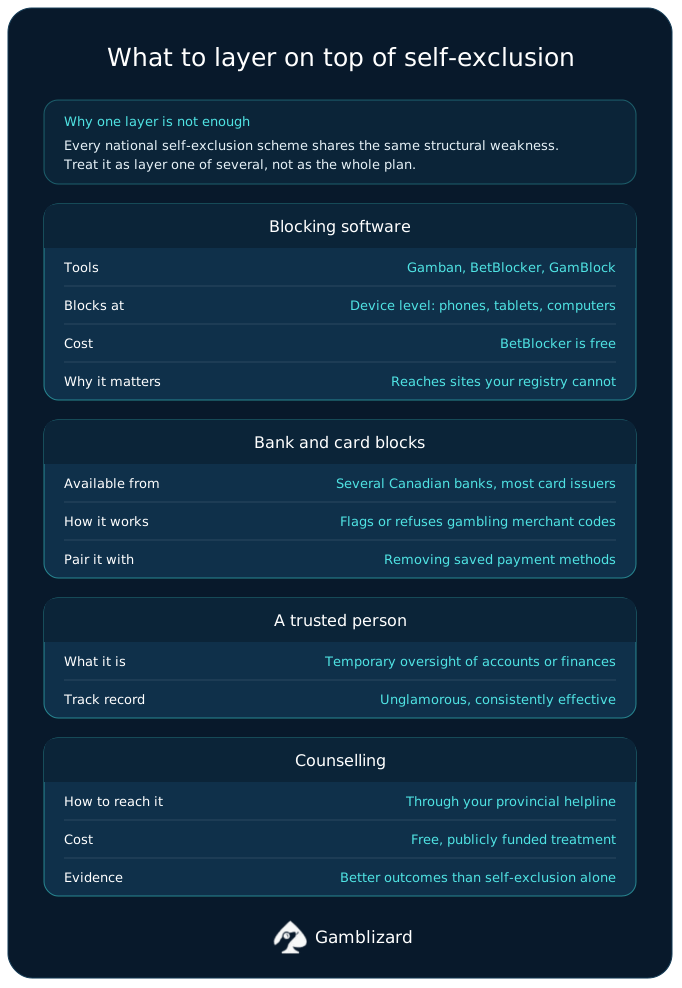
That gap is not unique to Canada. It’s the reason some groups have pushed for a self-exclusion system that works across borders.
The Global Self-Exclusion Initiative
Because national schemes stop at national borders, there has been a long-running push for something wider. The Global Self-Exclusion Initiative — launched by Casino Guru as a non-profit project in 2020 and made public in 2021 — aims to build a single system that would let a player block access to all online gambling at once, regardless of jurisdiction.
The obstacles are real: jurisdictions define self-exclusion differently, standards vary widely, identity verification does not travel well across borders, and no operator outside a licensing regime is compelled to participate. A survey run by the initiative found roughly 70% of gambling industry respondents believed such a system was needed, and the project has since expanded into comparative research on how self-exclusion is regulated across major markets.
For now, the closest working models are national rather than global: GAMSTOP in the UK, CRUKS in the Netherlands, Spelpaus in Sweden — and, in Canada, the provincial systems described above. Ontario’s BetGuard and Alberta’s AGLC program are the country’s first genuine steps toward market-wide coverage.
The Strengths and Limits of Self-Exclusion
Self-exclusion helps many people cut back or stop gambling, but no system catches every attempt to return. Research shows both where it works and where the gaps remain.
What the research supports
Self-exclusion reduces gambling frequency and expenditure for most participants, lowers self-reported harm, and improves psychological wellbeing during the exclusion period. Participants who combine it with counselling do measurably better than those who use it alone.
Where it falls
Breach rates are non-trivial. Land-based programs have historically recorded meaningful numbers of attempted entries by excluded participants each year, and detected breaches understate the real figure by definition. Online, breaches take the form of drifting to unlicensed sites rather than walking past a security desk — which is precisely why device-level blocking matters.
What improves outcomes
Longer terms, market-wide rather than single-operator coverage, easy enrolment that doesn’t require logging into a gambling site, active support during the exclusion, and a structured return process rather than an automatic reopening. Ontario’s BetGuard was designed around all five.
Those benefits matter most when the warning signs are recognized early enough to act on them.
Signs It Might Be Time to Self-Exclude
You don’t need to wait for a crisis before considering self-exclusion. If gambling is becoming harder to control or starting to affect other parts of your life, that can be enough reason to put a stronger barrier in place.
- Gambling has stopped being fun and started feeling compulsory.
- You’re chasing losses, or gambling to recover money rather than for entertainment.
- Your gambling is affecting your finances, sleep, work or relationships.
- You’ve broken your own deposit or time limits more than once.
- Someone close to you has raised it — even once, even gently.
- You’ve thought about taking a break and then talked yourself out of it.
- You’re hiding how much or how often you play.
If you decide to self-exclude, a few practical checks beforehand can make the process easier to manage.
A Practical Checklist Before You Self-Exclude
Five minutes of preparation makes the exclusion far more likely to hold.
- Withdraw your balances first — from every account, not just the one you play most.
- Remove saved payment methods and delete stored card details from your browser and phone.
- Register for the right scope. If you want to block both regulated online gambling and land-based casino play in Ontario, you may need BetGuard plus the relevant My PlayBreak registration.
- Install blocking software on every device you own, and set it to the longest term available.
- Delete the apps and unsubscribe from gambling newsletters and affiliate emails.
- Tell one person. Someone who will ask how it’s going in three weeks.
- Think carefully about the term. Some research suggests longer exclusions may be more effective than very short ones, and an active term generally cannot be shortened once it starts.
- Book the first support call now, while the decision still feels clear.
Self-exclusion can create the barrier, but you don’t have to manage everything around it alone. Support is available across Canada before, during, and after the exclusion period.
Support for Gambling Problems Across
Support is available across Canada, though the right service depends on your province.
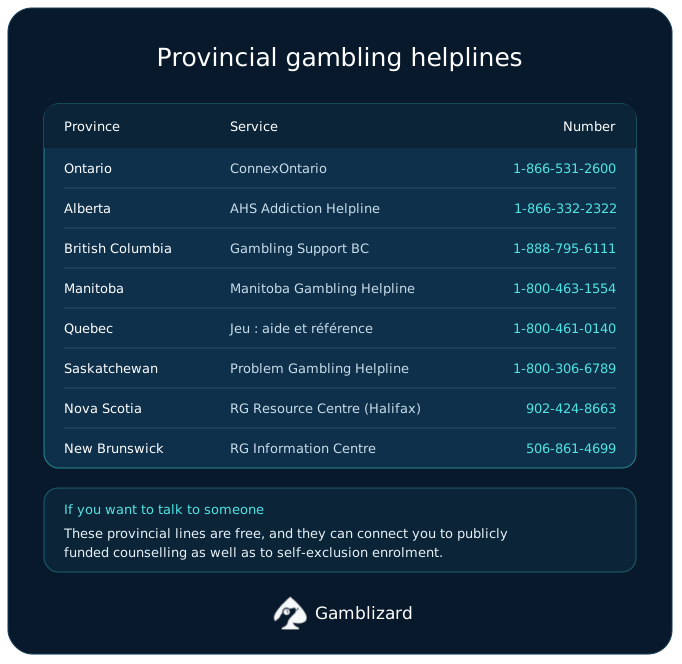
Self-exclusion works best when you don’t treat it as a temporary pause. In Ontario, BetGuard now makes it possible to block access across the regulated online market with one registration, while land-based play still requires separate coverage. The term cannot be shortened once it starts, so choosing the right scope and duration matters. If gambling is already becoming difficult to control, self-exclusion can give you distance, and support can help you make that distance stick.