
Overcoming Problematic Gaming Behaviour

- What Is Problematic Gaming Behaviour?
- How to Spot Gambling Addiction and Harmful Gaming Behaviour
- Myths and Facts About Gambling Addiction
- Why Problematic Gaming Behaviour Develops
- Quick Self-Check: The Problem Gambling Severity Index
- What Is Gambling Addiction Treatment?
- Gambling Addiction Help in Canada: Where to Start Today
- Building Barriers: Self-Exclusion and Money Controls
- Your First Seven Days
- Supporting Someone With Problematic Gaming Behaviour
Problematic gaming behaviour can take different forms, and gambling-related harm is among the most serious. Gambling disorder is a recognized medical condition that can affect finances, health and relationships, but treatment can help. Many people, however, delay seeking support. This guide explains the difference between problematic gaming and gambling addiction, the warning signs to watch for, what treatment involves and where to find help across Canada.
Problematic Gaming Behaviour Explained
Problematic gaming behaviour describes a pattern of video-game play that starts to interfere with everyday life. The amount of time spent playing is not enough on its own to define a disorder. Loss of control, growing priority given to gaming, and continued play despite negative consequences are more important signs.
Gaming and gambling can both become harmful, but they are not the same condition. That distinction matters when you are trying to understand the problem and what kind of support may help.
The Line Between Gaming and Gambling
Problematic gaming centres on video games. It can affect sleep, work, study, relationships, or other responsibilities. The World Health Organization recognizes gaming disorder in ICD-11, while the DSM-5-TR lists Internet Gaming Disorder as a condition requiring further study.
Gambling disorder is a separate diagnosis. The practical difference starts with what you put at risk. Gambling involves staking something of value on an uncertain outcome in the hope of receiving something of greater value. Video gaming doesn’t automatically meet that definition, even when play becomes difficult to control.
The boundary can become less clear when games include paid chance-based features. Loot boxes are a common example because players can spend money without knowing what reward they will receive. Research has found an association between loot-box spending and problem gambling, although that doesn’t prove that one causes the other.
Because gambling causes the bulk of measurable harm in Canada, the rest of this guide focuses on it.
Gambling Addiction and Gambling Disorder
Gambling addiction is commonly used to describe gambling disorder, a recognized behavioural addiction. It involves repeated gambling that becomes difficult to control and continues despite serious consequences for finances, health, work, education, or relationships.
The DSM-5-TR classifies gambling disorder as a behavioural addiction and places it in the same chapter as substance use disorders. That was a deliberate reclassification: research showed gambling disorder resembles substance addiction in how it presents, how it clusters in families, what happens in the brain’s reward circuitry, and which treatments work on it.
You will see several terms for roughly the same thing:
- Gambling disorder — the current clinical diagnosis.
- Compulsive or pathological gambling — older labels, same condition.
- Problem gambling — a broader umbrella for any gambling that disrupts life, whether or not it meets the diagnostic threshold.
- At-risk gambling — the early zone, where harm has started but is still small and reversible.
Gambling Disorder, Problem Gambling and At-Risk Play
Harm is a spectrum, not a switch. Canadian services measure it with the Problem Gambling Severity Index (PGSI):
| Band | PGSI score | What it typically looks like |
|---|---|---|
| Non-problem | 0 | Play stays inside a planned budget and a planned amount of time. Losing does not change your week. |
| Low risk | 1–2 | Occasional overspending or longer sessions than intended, without lasting consequences. |
| Moderate risk | 3–7 | Regular overspending, some chasing, arguments about money, early secrecy. Intervention here is most effective and least disruptive. |
| Problem gambling | 8+ | Loss of control, borrowing to gamble, hiding the extent of play, measurable damage to finances, health or relationships. |
People move between bands rather than sitting permanently in one. That cuts both ways: someone can slide from low risk to problem gambling in a few months after a life event, and someone in the problem band can move back down with the right support.
How Common Is Gambling Addiction in Canada?
Statistics Canada’s most detailed national measurement, from the 2018 Canadian Community Health Survey, found that 64.5% of Canadians aged 15 or older gambled in the past year — around 18.9 million people. Of those, 1.6%, roughly 304,400 people, were at moderate-to-severe risk of gambling problems, with a further 3.4% at low risk.
Two findings deserve pulling out, because they contradict what most people assume:
Lower-income households gamble less but are harmed more
71% of people in the highest-income households gambled, with 1% at moderate-to-severe risk. In the lowest-income households, 54% gambled — but 3% were at moderate-to-severe risk. The same dollar of losses simply takes a bigger bite.
Risk skews young and male
Participation peaks between 45 and 64, but harm concentrates in younger adults, and men are roughly twice as likely as women to develop problems. Women tend to start later but can progress faster once they do.
One caveat: that survey predates Ontario’s regulated online market and the current volume of single-event sports betting. National prevalence data has not caught up with the shift, and front-line services report rising demand — ConnexOntario has publicly flagged both higher call volumes and more complex cases since the market opened.
The Signs Gambling Is Becoming a Problem
Gambling addiction is sometimes called a hidden addiction. There is no slurred speech, no smell, no physical tell. Almost every sign is behavioural or financial, and almost everyone who develops the problem minimises it — including to themselves. That is exactly why knowing what to look for matters.
The Clinical Criteria (DSM-5-TR)
A clinician diagnoses gambling disorder when four or more of the following occur within twelve months:
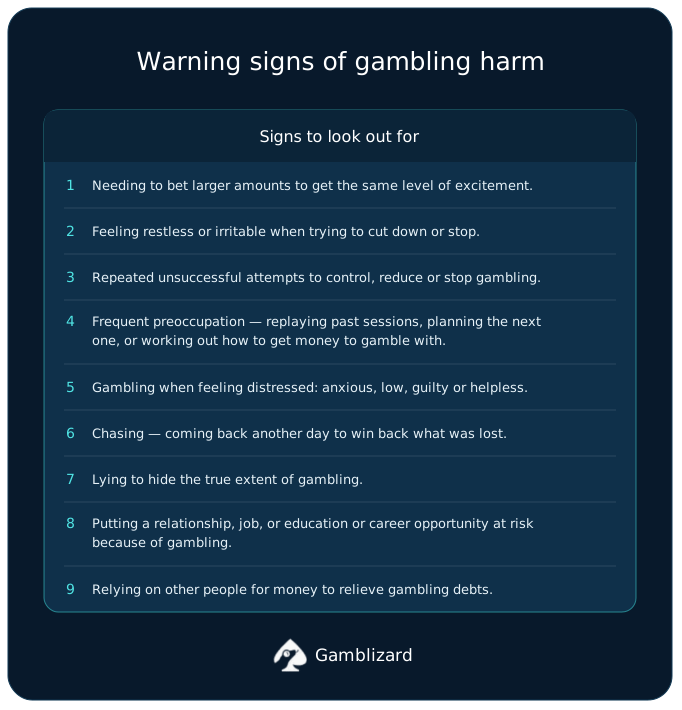
This list is for recognition, not self-diagnosis. Only a qualified clinician can make the call — but if four or more sound familiar, that is reason enough to phone a provincial helpline this week.
Behavioural Red Flags
- Sessions consistently run longer than planned, and “one more deposit” has become routine.
- Playing at unusual hours — 2am sessions, betting during work, gaming through family time.
- Turning the phone away, closing tabs quickly, being cagey about screen time.
- Opening accounts on other sites after hitting a deposit limit on one.
- Skipping meals, sleep, exercise or social plans to keep playing.
- Cancelling commitments that clash with a fixture or a session.
Financial Red Flags
Money is usually where the problem becomes visible first, often months before anyone talks about it.
- A paycheque that disappears within a day or two, every cycle.
- Borrowing to play: credit card cash advances, payday loans, buy-now-pay-later, lines of credit, friends and family, crypto.
- Selling belongings, or “loans” that are never repaid.
- Missed rent, utilities, or minimum payments while spending continues.
- Overdraft and NSF fees becoming a normal monthly occurrence.
- Secrecy around statements, a new account nobody knew about, unexplained e-transfers.
Emotional and Physical Red Flags
Disrupted sleep. Irritability that spikes and falls in a pattern nobody else can see the logic of. Anxiety tied to results. Low mood, guilt and shame after losses. Loss of interest in things that used to matter. Appetite changes. A background hum of panic about money.
Gambling disorder also carries a meaningfully elevated risk of suicidal thinking — higher than other addictive disorders. Any mention of suicide, however casual, should be taken seriously. Call or text 9-8-8.
Online-Specific Warning Signs
Online play removes the friction that used to limit harm: no travel, no closing time, no witnesses.
- Accounts spread across many operators, so no single one shows the full picture.
- Deleting an app and reinstalling it within days.
- Chasing deposit bonuses purely as a way to keep playing rather than for value.
- Moving to unregulated offshore sites after self-excluding from regulated ones. This is one of the clearest signals that control has been lost — and it strips away every consumer protection, deposit limit and payout guarantee that regulated operators are required to provide.
- Late-night in-play betting, where decisions get made in seconds.
The same signs can look different from the outside. In someone else, gambling problems often show up through changes in behaviour, finances, and routines before they are openly discussed.
Signs of Gambling Addiction in Someone Else
You may not see the gambling itself. More often, you notice what changes around it: money that no longer adds up, unusual secrecy about finances, missed plans, mood changes, or explanations that keep shifting. None of these signs proves there is a gambling problem on its own, but a pattern is worth paying attention to.
If you raise the subject, focus on what you have noticed rather than pushing for a number or an admission. Asking “How much did you lose?” can put someone on the defensive. A calmer observation, such as “You’ve seemed really low after the games lately. Is something going on?”, leaves more room for an honest conversation.
Don’t expect the first conversation to settle everything. Start by making your concern clear without turning it into an argument. Let the person know you have noticed a change, that you are willing to listen, and that you want to help if they decide to talk about it.
Gaming Behaviour in Teens: Loot Boxes and Packs
Younger adults carry disproportionate risk, and gambling advertising reaches them constantly through sports broadcasts and social feeds. With teenagers, treat spending patterns as the signal rather than hours played. Long play sessions are common and usually harmless; repeated purchases of packs or boxes, borrowing money to buy them, and real distress when a pull goes badly are much closer to gambling harm.
Other things worth watching: fluency in odds, lines and parlays out of proportion to a casual interest; betting among friends on games; frequent small borrowing; sudden money with no clear source; mood swings that map onto fixture schedules.
Parents have more influence here than they usually assume. Explaining honestly how the odds work, modelling restrained behaviour and keeping the topic open beats trying to police devices.
Myths and Facts About Gambling Addiction
Gambling addiction still comes with assumptions about money, willpower and what a person with a problem is supposed to look like. Those ideas can make harmful gambling harder to recognize and can delay support.
| Myth | Fact |
|---|---|
| You have to gamble every day to have a problem. | Frequency is irrelevant. Someone who bets once a month can be in serious trouble. Harm defines the problem. |
| It is really just a money problem. | Financial damage is a symptom. Clearing the debt without treating the disorder reliably leads to more gambling and more debt. |
| It comes down to willpower. | Gambling disorder is a recognised behavioural addiction affecting people across every income and education level. Disciplined, competent people develop it. |
| If they can afford it, it is not a problem. | Time lost, secrecy, damaged relationships and deteriorating mental health all occur independently of affordability. |
| Paying off their debt will help them stop. | Bailing someone out without a treatment plan is one of the most reliable ways to enable continued gambling. |
| Online gambling is safer than a casino. | Online is available 24/7, entirely private, and lives on the device already in your hand. It removes every natural stopping point a venue provides. |
| You have to hit rock bottom before treatment works. | The opposite. Outcomes are best when people get help in the moderate-risk band, before debt and relationship damage compound. |
Problematic behaviour rarely develops for a single reason. Personal, psychological and environmental factors can all play a part.
The Roots of Gambling and Gaming Harm
There is rarely a single cause. Both gambling addiction and harmful gaming behaviour develop where biology, circumstance and easy access overlap.
How the Brain's Reward System Is Involved
Betting triggers a reward response whether or not you win. Two features make that response unusually strong: variable payouts, where rewards arrive unpredictably, and near-misses, where two matching symbols and a third just off the line register in the brain much like a win rather than a loss.
Over time, the same stake produces a smaller response, so stakes escalate to reach the same feeling. That is the tolerance mechanism seen in substance addiction, and it is a large part of why “just stop” is far harder from the inside than it looks from the outside. It is also, not coincidentally, the exact loop that loot boxes and card packs reproduce.
Who Is Most at Risk in Canada
Based on Statistics Canada data and Canadian clinical research, risk is higher among people who are:
- Younger and male.
- In lower-income households.
- Single, divorced or separated.
- Rating their own mental health as fair or poor.
- Playing many different gambling formats rather than one.
- Living with a family history of addiction.
- High in trait impulsivity.
- Carrying the memory of an early large win — a well-documented risk factor, because it sets an expectation the maths cannot sustain.
Conditions That Often Occur Alongside It
Depression, anxiety disorders, ADHD, bipolar disorder, and alcohol or substance use disorders all co-occur with gambling disorder at elevated rates. This matters practically: treating the gambling while leaving an untreated depression or ADHD in place tends not to hold, because the underlying driver is still there. A good assessment screens for all of it.
One specific and often-missed cause: dopamine agonist medications prescribed for Parkinson’s disease and restless legs syndrome are a documented trigger for new-onset compulsive gambling. If gambling problems began after starting one of these, tell the prescribing doctor — do not stop the medication on your own.
Quick Self-Check: The Problem Gambling Severity Index
The PGSI is the standard screening tool used by Canadian public health services. It asks nine questions about the past twelve months. Score each 0 (never), 1 (sometimes), 2 (most of the time) or 3 (almost always), for a total between 0 and 27.
In the past 12 months, how often have you:
- Bet more than you could really afford to lose?
- Needed to gamble with larger amounts of money to get the same feeling of excitement?
- Gone back another day to try to win back money you lost?
- Borrowed money or sold anything to get money to gamble?
- Felt that you might have a problem with gambling?
- Felt that gambling has caused you health problems, including stress or anxiety?
- Had people criticise your betting or tell you that you had a gambling problem, regardless of whether you thought it was true?
- Felt that your gambling has caused financial problems for you or your household?
- Felt guilty about the way you gamble or what happens when you gamble?
Reading your score: 0 = non-problem gambling. 1–2 = low risk. 3–7 = moderate risk. 8 or more = problem gambling.
Support and Treatment for Gambling Problems
Gambling addiction treatment is a structured programme — usually talking therapy, often combined with financial counselling and peer support, and sometimes with medication for co-occurring conditions — aimed at stopping or controlling the gambling and repairing the damage it caused.
Three things about it surprise most people:
- In most of Canada it is publicly funded and free at the point of access.
- You usually do not need a doctor’s referral, and you do not need to have already quit before you call.
- Abstinence is not always the goal. For some people the plan is controlled, limited play; for others it is stopping entirely. That decision is made with a counsellor, not imposed at the door.
Gambling Addiction Therapy: What Actually Works
Cognitive behavioural therapy (CBT)
Has the strongest evidence base. It works on three fronts: identifying the specific triggers that precede a session, challenging the distorted beliefs that sustain gambling (the gambler’s fallacy, the illusion of control, “I’m due for a win”, “I only need one good night to get straight”), and building concrete alternative responses to urges. A typical course runs 8–12 sessions.
Motivational interviewing
Is often used at the start, or on its own for people not yet sure they want to stop. Rather than arguing someone into change, it works through their own ambivalence. Brief motivational interventions have produced measurable reductions even as standalone treatment.
Group therapy
Attacks the isolation and shame that keep the problem hidden, and adds accountability individual therapy cannot.
Family and couples therapy
Addresses the secrecy, rebuilds trust and establishes workable money boundaries. Family involvement is one of the stronger predictors of durable recovery, partly because it removes the need to keep managing a lie.
Psychodynamic therapy
Explores what the gambling is doing for the person — escape, self-soothing, excitement, self-punishment — which matters when previous attempts to stop collapsed for reasons nobody could explain.
Financial and credit counselling
Runs alongside the therapy rather than after it. Debt pressure is one of the most reliable relapse triggers, so leaving it unaddressed for six months undermines everything else.
Medication
There is no medication approved specifically for gambling disorder in Canada. What prescribers do treat are the co-occurring conditions — depression, anxiety, ADHD — and doing so often reduces gambling indirectly by removing what was driving it. Any decision about medication belongs with a physician or psychiatrist who knows the full picture.
Levels of Care
| Level | What it involves | Best suited to |
|---|---|---|
| Helpline and brief intervention | One call, immediate support, referral, sometimes brief telephone counselling | Anyone, at any stage. This is the front door |
| Outpatient counselling | Weekly or biweekly sessions with a gambling-specialist counsellor while living at home | The majority of cases |
| Intensive outpatient / day programme | Several sessions a week or full days, with structure and group work | When weekly sessions are not holding, or urges remain severe |
| Residential treatment | Live-in programme providing distance from triggers and a full daily structure | Severe cases, safety concerns, or concurrent conditions needing treatment |
| Peer support | Ongoing group meetings, in person or online, free and open-ended | Alongside any of the above, and after formal treatment ends |
What Treatment Costs in Canada
Gambling-specific counselling delivered through provincial health and addiction services is free to residents. Provincial helplines will route you to it, including publicly funded residential options where they exist. Private residential programmes are not covered by provincial health plans and can run into the tens of thousands of dollars — worth checking whether the free options meet your needs first.
Two funding routes people forget: many employer benefit plans include an Employee and Family Assistance Programme covering counselling sessions, and extended health plans often cover a registered psychologist or psychotherapist.
Gambling Support Across Canada
Every province and territory has a free, confidential line. You do not need to have decided to quit, you do not need a diagnosis, and you do not need to be the person gambling — these lines support family members too.
Provincial and Territorial Helplines
| Province / Territory | Service | Phone |
|---|---|---|
| Alberta | Addiction and Mental Health Helpline | 1-866-332-2322 |
| British Columbia | Gambling Support BC | 1-888-795-6111 |
| Manitoba | Manitoba Addictions Helpline | 1-800-463-1554 |
| New Brunswick | Gambling Information Line | 1-800-461-1234 |
| Newfoundland and Labrador | Problem Gambling Help Line | 1-888-899-4357 |
| Northwest Territories | NWT Help Line | 1-800-661-0844 |
| Nova Scotia | Problem Gambling Help Line | 1-888-347-8888 |
| Nunavut | Kamatsiaqtut Help Line | 1-800-265-3333 |
| Ontario | ConnexOntario (24/7, 170+ languages) | 1-866-531-2600 · text CONNEX to 247247 |
| Prince Edward Island | Problem Gambling Help Line | 1-855-255-4255 |
| Quebec | Jeu : aide et référence | 1-800-461-0140 |
| Saskatchewan | Problem Gambling Helpline | 1-800-306-6789 |
| Yukon | Mental Wellness and Substance Use Services | 1-866-456-3838 |
Crisis, anywhere in Canada: 9-8-8, by call or text, 24/7, in English and French.
Peer Support Groups
- Gamblers Anonymous — 12-step fellowship with in-person and online meetings across Canada. Free, no registration.
- Gam-Anon — the parallel programme for family and friends.
- SMART Recovery — a secular, CBT-based alternative for people who do not want a 12-step framework.
- GamTalk — free, moderated online peer community, useful when meetings are not accessible, or the anonymity of text is easier to start with.
Free Debt and Credit Counselling
Non-profit credit counselling agencies provide free budgeting help and can negotiate repayment plans with creditors. Look for member agencies of Credit Counselling Canada. Be wary of for-profit “debt settlement” companies that charge upfront fees and advertise heavily to exactly this audience — a Licensed Insolvency Trustee or a non-profit agency is the safer first call.
Support for Family Members
Provincial services treat affected family members in their own right, not just as an adjunct to the gambler’s treatment. You can get counselling for yourself even if the person gambling refuses to engage — and doing so tends to improve the odds that they eventually do.
Building Barriers: Self-Exclusion and Money Controls
Therapy changes how you respond to an urge. Barriers reduce how often you face one, and buy time when you do. Both matter; neither substitutes for the other.
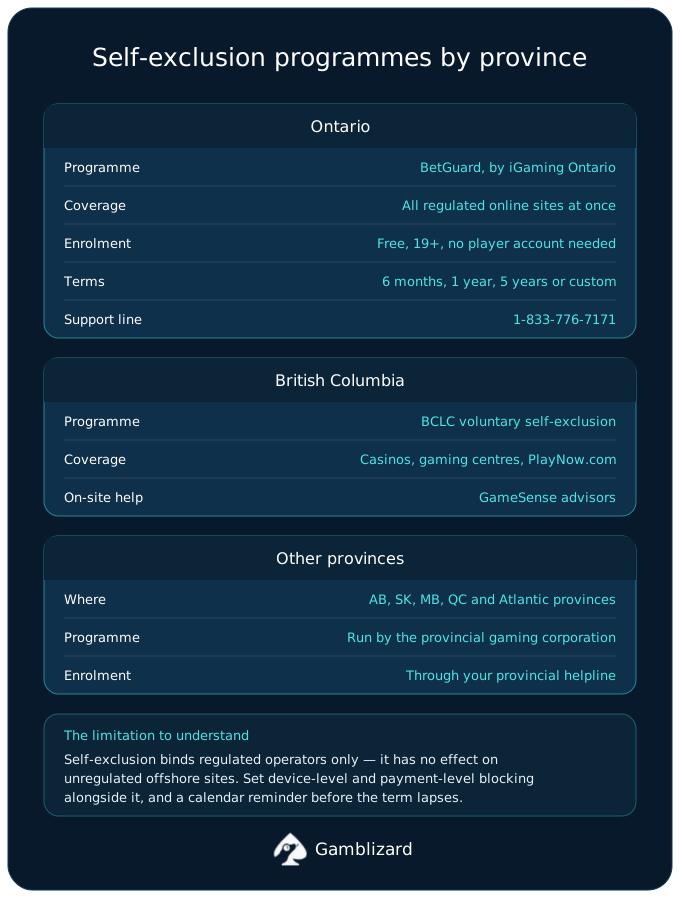
Device and Payment Blocking
- Gambling blocks on your bank card. Most Canadian banks and card issuers can block gambling merchant categories on request. Very few people know to ask — this is one of the highest-impact five-minute actions available.
- Blocking software on phone, laptop and router. Choose one where an adult you trust holds the password.
- Delete saved cards and autofill from every browser and app, so no purchase is one tap away.
- Lower daily debit, credit and e-transfer limits at your bank.
- Ask a trusted person to hold your cards during the first weeks. Temporary scaffolding, not a permanent arrangement.
- Turn on transaction alerts so someone other than you can see the pattern.
Your First Seven Days
The first week is about creating distance from gambling and putting practical support in place. You don’t need to solve everything at once. A few concrete steps can reduce easy access, bring someone else into the picture, and turn the decision to stop into a plan you can follow.
| Day | Action | Why it matters |
|---|---|---|
| 1 | Call your provincial helpline. One call, no commitment. | Breaks the secrecy and gets you a real referral instead of a search result. |
| 1 | Tell one person you trust. | Accountability, and the relief of not managing the lie alone. |
| 2 | Enrol in self-exclusion; install a blocker on every device. | Removes the easiest routes back. |
| 3 | Call your bank: gambling block, lower limits, alerts on. | Adds friction at the exact moment friction is needed. |
| 4 | Write every debt on one page. Do not act on it yet. | Vagueness fuels panic; panic fuels chasing. |
| 5 | Book the first counselling appointment the helpline offered. | Momentum is fragile in week one. |
| 6 | Contact a non-profit credit counsellor. | Debt pressure is a top relapse trigger — start early. |
| 7 | Attend one peer meeting, online or in person. | Costs nothing, and reframes the problem as shared rather than shameful. |
Slips are common and are not a failure. What separates a lapse from a return to full problematic gaming behaviour is how quickly it gets named and acted on. Measure progress by trend over months, not by an unbroken streak.
One useful mechanic to add to the existing plan: urges peak and fall. Most pass within 20 to 30 minutes if nothing feeds them. That is the entire logic behind the delay tactic — you are not resisting indefinitely, you are outlasting a curve that is already on its way down.
Supporting Someone With Problematic Gaming Behaviour
Supporting someone doesn’t mean diagnosing them or trying to fix everything for them. Your role is to notice what has changed, raise your concern calmly, and help make the next practical step easier. At the same time, you need clear boundaries around money, trust, and the effect the behaviour is having on you.
How to Start the Conversation
Pick a calm, private moment — not the aftermath of a discovered loss. Start with specific changes you have noticed instead of labelling the person or telling them they have an addiction. For example, focus on missed plans, money problems, secrecy, or mood changes.
Don’t issue an ultimatum you are not prepared to follow through on. A threat that gets walked back teaches that the next one can be ignored too.
Do’s and Don’ts
| Do | Don’t |
|---|---|
| Get support for yourself — Gam-Anon, or your provincial service | Take on the role of monitoring their every transaction |
| Take control of household finances, and check statements | Clear their debts without a treatment plan attached |
| Stay calm, and recognise their good qualities | Lecture, preach, or lose your temper mid-conversation |
| Explain the situation to your children in age-appropriate terms | Cover up the problem to family, employers or yourself |
| Expect recovery to take time and include setbacks | Assume every problem resolves the day the gambling stops |
| Keep them included in family life | Treat them as a moral failure |
Protecting Yourself Financially
You are allowed to protect yourself, and doing so is not a betrayal. Separate your own accounts. Pull your credit report from Equifax and TransUnion (free) to check for accounts opened in your name. Stop co-signing anything. And decide in advance — in writing, with someone else — how you will answer requests for money. Requests get skilled and persistent; a decision made in the moment is a decision made under pressure.
When It’s a Crisis
Take any talk of suicide seriously and act immediately: 9-8-8 by call or text, or 911 if there is immediate danger. The elevated suicide risk attached to gambling disorder is well documented, and the shame that follows disclosed losses is a specific danger point.